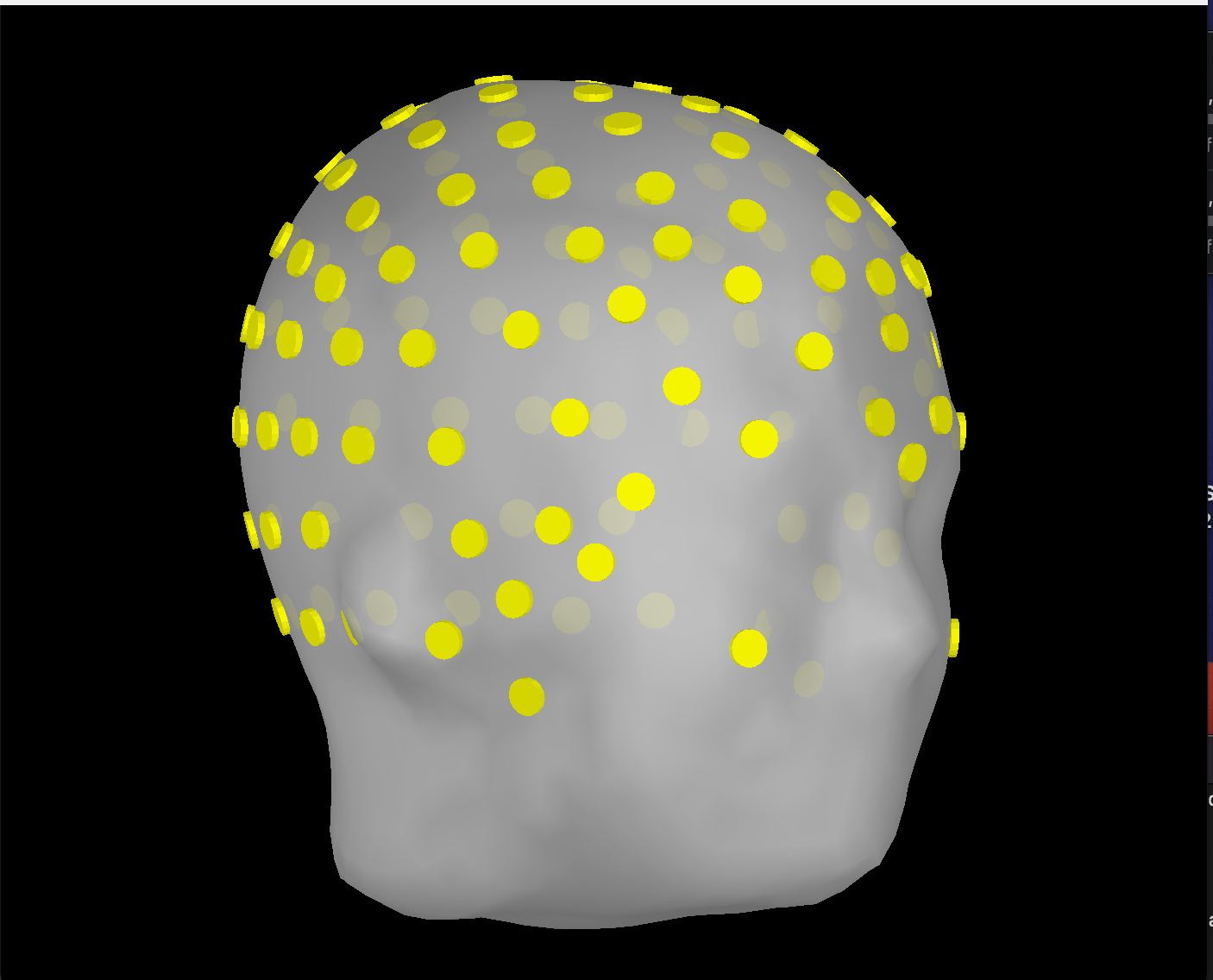
Throughout my work thus far, I've worked with 68 Neuroscan EEG headsets with the full MRI or template brains. However, I am now working on a dataset that has 128 EGI headset and only defaced MRIs.
I wanted to ask in this case (with no recorded digitized head points), if I am registering the channels in an appropriate way.
My main concern is that with the EGI system, there are electrodes on the face (below the scalp). Although one could manually inspect these with a full (non-defaced) MRI, working with the defaced MRI leads to this part of the head being empty space.
For example, doing manual registration of electrodes for one participant led to this:
I am concerned that the electrodes highlighted in red may not be registered correctly. Are there any recommendations in this case? I was thinking of deleting such electrodes entirely from participants to avoid the issue, and due to the number of channels, I assume it won't have too much of an effect on source localization.
Any input on this would be greatly appreciated.
Paul
This is an important issue with defaced data and I would recommend reporting it to the original data provider. Your example employs a somewhat extreme defacing method, but there are other alternatives. Not only does it makes coregistration difficult, but it also prevents proper head modeling. Not only the red electrodes would be affected (I'm not sure how Brainstorm deals with electrodes "off" the skin - it probably projects them to the nearest point?), but all the ones neighboring the removed face.
I don't have a good solution to recommend. Other than removing electrodes, maybe you could manually extend the scalp surface to grossly recreate the missing face, or merge it with part of a template. It wouldn't really help for coregistration, but could minimize effects on the head model. Unfortunately, I don't think Brainstorm has this kind of functionality.
Below is an example participant where I ran the "refacing", then CAT12 segmentation, and then manually aligned the electrodes using "MRI Registration > Edit":
I wonder what others thoughts are on this? Of course it's not the ideal situation (I should also mention that this new dataset I am working with is children and youth, so using an MNI template isn't the best), but seems like a potential option? Or would you suggest deleting the electrodes that are not on the surface.
Thank you for this reference, I will look at how to interface it directly with Brainstorm (as I did for the mri_deface from FreeSurfer, or this SPM method)
I am working with is children and youth, so using an MNI template isn't the best
Make sure that the "refaced" MRI is not any bigger than the original one.
Of course it's not the ideal situation, but seems like a potential option?
If you are not working with the actual subject surfaces, you won't be able to locate correctly the electrodes. A template position would probably be better than nothing.
Or would you suggest deleting the electrodes that are not on the surface.
Another question is: do you want to keep the face electrodes?
Do you really expect these electrodes on the cheeks to record anything but muscle activity (ocular and facial)? If there is no brain data, you don't want to include then in the source estimation process.
Another question is: do you want to keep the face electrodes?
Do you really expect these electrodes on the cheeks to record anything but muscle activity (ocular and facial)? If there is no brain data, you don't want to include then in the source estimation process.
Great point. Perhaps I can remove those electrodes that I don't believe will have much brain data. Do you have any suggestions/rule of thumbs as to which electrodes you would remove in such a case?