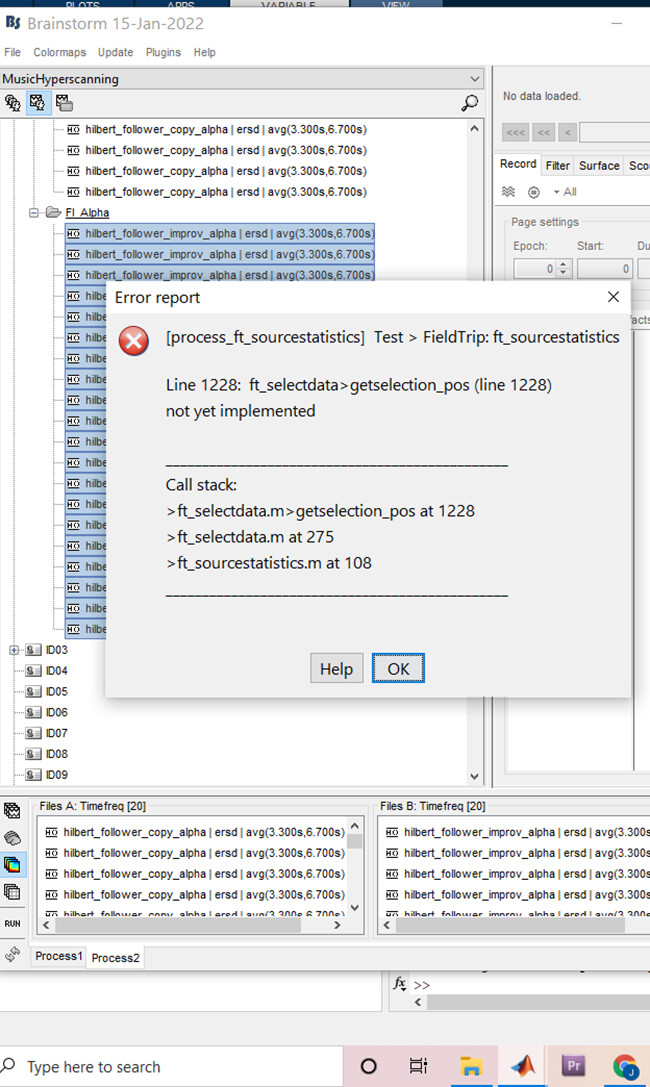
I am trying to run a source level cluster analysis on source-level time-frequency decomposed maps derived from MEG data and mapped onto the ICBM template.
Can you help me interpret what this means? How about if the error is at line 1233?
Strangely, I have no problem running cluster analysis on source-level time-frequency (Hilbert) decomposed data from a different protocol based on EEG data.
I appreciate you kind advice as always whenever you have time.
I am trying to run a source level cluster analysis on source-level time-frequency decomposed maps derived from MEG data and mapped onto the ICBM template.
Be careful, this requires gigantic amounts of memory.
Can you help me interpret what this means? How about if the error is at line 1233?
This error is returned by FieldTrip when the 3D positions associated with the selected signals are different between input files. This could mean that not all the input files have been properly projected onto the anatomy template. You need to fix the input files before running this process.
Be careful, this requires gigantic amounts of memory.
Thank you. I forgot to mention that they have been averaged over time. Also, my computer is a beast. It works great with files from a different study and only takes a minute or two tops.
This error is returned by FieldTrip when the 3D positions associated with the selected signals are different between input files. This could mean that not all the input files have been properly projected onto the anatomy template. You need to fix the input files before running this process.
Could this be because the anatomy template was warped to match the headpoints (It is an MEG study)? If yes, is there a way to standardize the 3D positions downstream of warping? (I feel like there is a thread on this...)
Thank you. I forgot to mention that they have been averaged over time.
Rather than averaging in time some time-frequency decomposition, maybe you could compute directly the power spectrum averaged by frequency bands (PSD process). You would benefit from a better estimator at a much lower computational cost.
Could this be because the anatomy template was warped to match the headpoints (It is an MEG study)?
Yes, definitely: the various source maps are matching point-to-point, can be averaged directly and mapped onto the MNI ICBM152 cortex available in the (Default anatomy) folder, but the actual positions of the vertices is different and therefore the FieldTrip functions will not accept them in input.
If yes, is there a way to standardize the 3D positions downstream of warping?
Project explicitly the spectrum files on the default cortex of the default anatomy (e.g. cortex_15000V).
This would ensure that all the files use the same reference 3D positions, and FieldTrip should stop complaining.
Rather than averaging in time some time-frequency decomposition, maybe you could compute directly the power spectrum averaged by frequency bands (PSD process). You would benefit from a better estimator at a much lower computational cost.
Thank you for this advice. For the present study, I also am also interested in showing the time-course of power changes over the experimental epoch, so Hilbert seemed to serve me best. However, I have other studies where that is not the case, and PSD would certainly be a more practical approach.
Project explicitly the spectrum files on the default cortex of the default anatomy (e.g. cortex_15000V). This would ensure that all the files use the same reference 3D positions, and FieldTrip should stop complaining.
It did indeed stop FieldTrip from complaining. Thank you very much!!