ERROR IN Simulate recordings from scouts

Hello,
I finally made a simple Matlab function that provides Spike like behavior for the signal.
Made 2 signals with 6 seconds duration signal using simulating generic signals.
Also made 2 scouts on the brain.
Now I am trying to simulate recording from scouts.
Yes I have electrodeposition (19 electrodes from default)
Yes, I have projected them on the surface of the head.
Yes, I have generated the spherical head model.

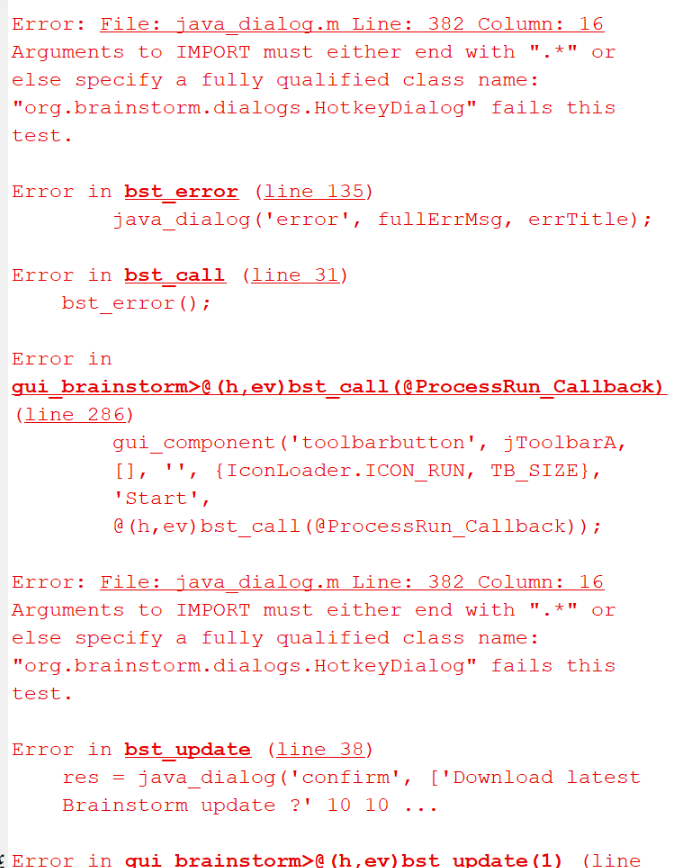
But I am getting the following error on the command line of the Matlab when I press run in the simulation recordings from scouts
image

Error: File: java_dialog.m Line: 382 Column: 16
Arguments to IMPORT must either end with ".*" or
else specify a fully qualified class name:
"org.brainstorm.dialogs.HotkeyDialog" fails this
test.

Error in bst_error (line 135)
java_dialog('error', fullErrMsg, errTitle);

Error in bst_call (line 31)
bst_error();

Error in
gui_brainstorm>@(h,ev)bst_call(@ProcessRun_Callback)
(line 286)
gui_component('toolbarbutton', jToolbarA,
, '', {IconLoader.ICON_RUN, TB_SIZE},
'Start',
@(h,ev)bst_call(@ProcessRun_Callback));

Error: File: java_dialog.m Line: 382 Column: 16
Arguments to IMPORT must either end with ".*" or
else specify a fully qualified class name:
"org.brainstorm.dialogs.HotkeyDialog" fails this
test.

Error in bst_update (line 38)
res = java_dialog('confirm', ['Download latest
Brainstorm update ?' 10 10 ...

Error in gui_brainstorm>@(h,ev)bst_update(1) (line
157)
gui_component('MenuItem', jMenuUpdate,
, 'Update Brainstorm',
IconLoader.ICON_RELOAD, ,
@(h,ev)bst_update(1), fontSize);

Hi!

This error indicates that the Java portion of Brainstorm you’re running is outdated. Make sure your Brainstorm is fully up to date and then restart Brainstorm and Matlab to make sure it loads the updated Java.

Since this seems to happen when you try to open up Java dialogs, the Updater built in the software might not work, so you’ll probably have to download the new version yourself from our website (brainstorm_XXXXXX.zip) and replace your current brainstorm3 folder: https://neuroimage.usc.edu/bst/download.php

I hope this helps!
Martin

Thank you Martin for your reply.
I did as you said, now I am getting the following Error when trying to perform simulate recording from scouts:

It seems you’re trying to add noise to your simulated recordings based on a noise covariance matrix, but Brainstorm cannot find said matrix. Are you sure you generated one and it is available in the same folder as your input to this process?

1 Like

Thank you Martin , yes the problem was with noise covariance matrix as I did not define it separately.
Now I have a problem with defining one. When I use identity matrix it works well, but i cant make a covariance noise matrix from the data itsef

There is no option for generating noise covariance matrix with simulated data. Please let me know if there is one?
Also what is the benefit of covariance matrix? Would it make the simulation more realistic if i use covariance matrix from real eeg data?

The noise covariance is used here for generating noise with realistic cross-correlation between sensors.
If you are using an identity matrix, it will generate EEG signals that are completely uncorrelated, which is not realistic: two adjacent electrodes always pick up similar noise patterns (instrumental and physiological).

The only solution I know for generating such a covariance matrix is to compute it from real EEG signals.

1 Like

Thank you @Francois .
Thats what I noticed too, yet I have not found real eeg data with same number of electrodes (19 or 61) so i can use that covariance.
I will definitely post a new discussion about generating realistic signals if I find found a decent way, because I noticed that in dosscusions many had the similar question.

I was just wondering where can I get more information abou how SNR of signal level and Noise level are computed, seems lik when i set higher SNR in signal and source the output is noisier? How can I know what would be the overAll SNR of the simulation?

Thankyouuu

If you declare that the recordings are noisier (lower Signal-to-Noise-Ratio), there will be a higher regularization of your recordings before inversion, and the resulting source maps will look smoother. The other way around, if your indicate that the SNR is high, you tell the model not to smooth much your recordings, therefore it may look noisier/patchier in the end.

In a case of a simulation, you can define what SNR to impose on your recordings.

Francois

1 Like

Thank you very much for your explanation about regularization.

Are you referring to the noise section of the picture below? If yes, what would be the overall SNR? Should I export the final simulation and use SNR function in Matlab from non-epileptic time zone and epileptic time zone as Noise and Noise+Signal to compute SNR or is there a more proper way to find the overall SNR in Brainstorm?

I’m not sure how to get the SNR you should use for source estimation from these simulation parameters.
@Sylvain @John_Mosher @leahy @hossein27en @rey?

Otherwise, recompute it directly from the simulated signals using Matlab…

1 Like