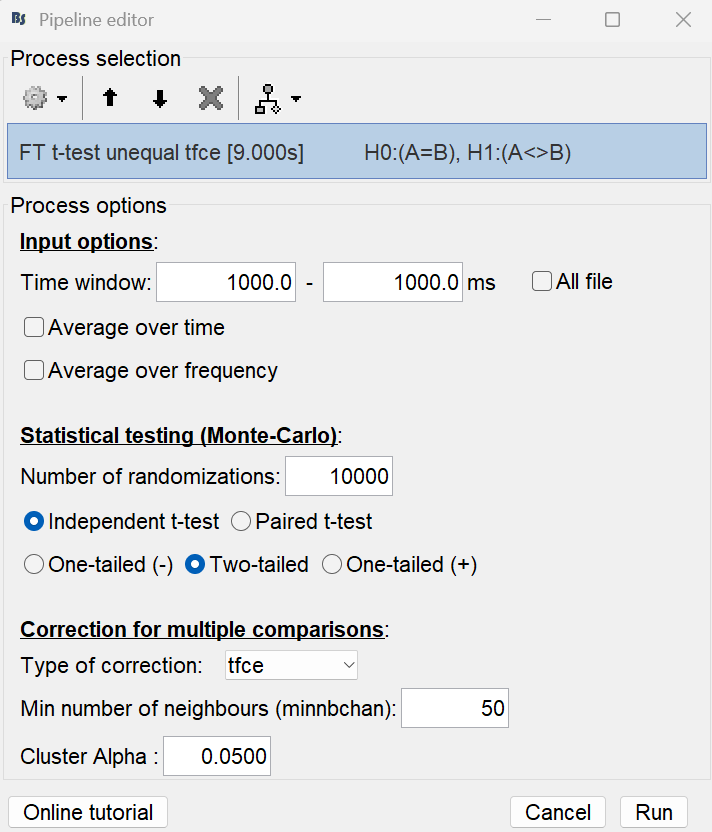
I conducted source-level permutation statistics in Brainstorm using the Threshold-Free Cluster Enhancement (TFCE) method available in FieldTrip. The settings are shown in the attached image.
I set the “Min number of neighbours” to 50, but the results still seem to include some clusters that are quite small.
What does “Min number of neighbours” mean?
Additionally, is it possible to adjust or control cluster size when performing TFCE-based source-level permutation statistics?
The statistic testing (method) is Monte-Carlo, TFCE is the method to do multiple-comparison correction.
The behaviour that you observe happens as the option Min number of neighbors is only valid when using the correction method cluster.
When using cluster correction, a cluster will be kept if it has at least minnbchan (Min number of neighbors (time, frequency, spatial) elements that are supra-threshold neighbours.
fieldtrip/private/findcluster.m at master · fieldtrip/fieldtrip · GitHub
Thank you for your reply.
I am currently performing source-level analysis using a 15,000-vertex source space.
Is it appropriate to apply TFCE in this case?
Also, do I need to specify the “Min number of neighbours” parameter when using TFCE on a source space of this size? If there is a recommended value, I would appreciate your advice.
As it name indicates, threshold-free cluster enhancement method (TFCE) was introduced by Smith and Nichols (2009) to overcome the manual selection of the clusteralpha threshold. Thus if cluster correction is appropriated to your data, also TFCE correction is. You can find detailed information on cluster statistics and TFCE in there FieldTrip pages.
The option Min number of neighbors is only valid when using the correction method cluster.
So it does not have any effect if using TFCE as correction method.
 page)
page)