I am currently working on preprocessing fNIRS data using NIRSTORM and I had two questions that I wanted to clarify.
When detecting bad channels, is there a prefered method between SCI detection and coefficient variation. Further, is it best to use both on the dataset?
To confirm, is it best to use TDDR motion correction before applying the MBLL to convert the optical densities?
I wish I could answer this question. but i am not sure if there is a clear consensus on that in the community yet. I prefer CV, but the field is slowly moving toward SCI. I recommend trying one of them and visually inspecting the bad channels to see which channels were rejected. in my experience, SCI tended to reject too many channels even though i would have considered them as good.
Yes. you want to apply TDDR on the optical density (so after raw → dOD, but before dOD → delta [HbO], [HbR], [HbT] ).
Nirx recently published 2 videos on data quality that might give some advice:
Thank you for your reply. Given this, I will need to reprocess the data that we have using this order for motion correction and I will switch to SCI. I had another question I wanted to clarify:
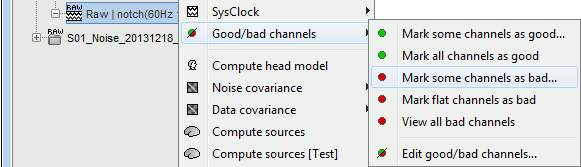
→ Once you detect bad channels in the raw file, and certain channels are flagged and removed, are they permanently removed from that raw file? That is, if I have to re-process my data with a different bad channel detection method (SCI instead of CV), would I need to re-upload the participant data to do so, or is there a way to reset the raw file to have all of the original channels?
Also, would you be able to confirm that this is the appropriate order for the full protocol?