
General information
When: Friday, August 31, 2012 - (9am - 6pm)
Where:Brain & Spine Institute, Hôpital de la Salpêtrière, Paris (France)
Motivation: Academic software applications for MEG and EEG data analysis have grown considerably over the past decade, reaching to an increasing number of users and achieving higher degrees of sophistication (Baillet et al., 2011). Brainstorm is a software project that is entering its second decade of development and distribution, with an open-source and free-of-charge policy. More 4000 users have downloaded Brainstorm's code or executable packages (which do not require a Matlab license), and 500 registered active users access the software updates on a regular basis. Brainstorm's user community is growing rapidly and features a great variety of research areas in MEG and EEG. We believe Brainstorm is serving well its users, in terms of facility and convenience of utilization and improvements in productivity and reproducibility of their research output. More than 90 journal articles feature results obtained using Brainstorm. The software is now featuring new elements for scripting large batches of data workflows (automated analysis pipelines, group analyses, etc.) and users can plug in their own processes for data analysis. As the user community is growing in size and diversity, we wish to feature some of the most exciting and cutting-edge usage of the software and communicate the essential elements of the application to other researchers.
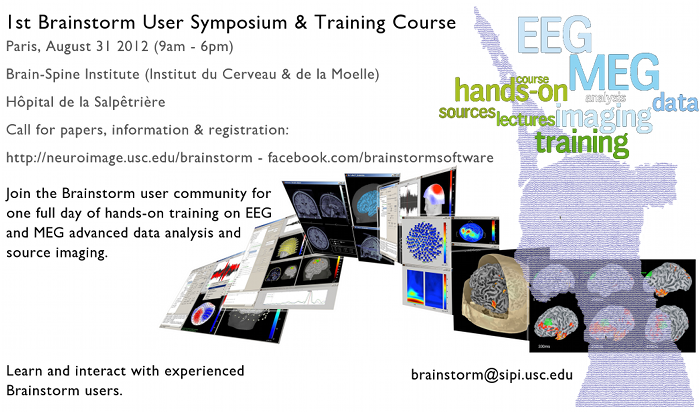
About this Symposium & Training Clinic: ThisBiomag Satellite Symposium will feature both oral communications from Brainstorm users and a full hands-on training course. Participants need to bring their own laptops to practice with Brainstorm. The benefit is that they will be able to reproduce the steps taken during the training, when back to their home institution. We anticipate it will be a unique opportunity for the Biomag community to provide feedback on the software, to help its developers improve and provide new features, and to carry in-depth insight about current and future developments to new users.
Cited Reference: Baillet, S.; Friston, K. & Oostenveld, R. (2011) Academic software applications for electromagnetic brain mapping using MEG and EEG. Comput Intell Neurosci, 972050
Program:
09:00 - 09:30: MEG & EEG source imaging crash course: concepts, jargon & foundations (Sylvain Baillet, McGill University)
09:30 - 10:00: Brainstorm overview: software architecture, typical data workflow (Francois Tadel, McGill University)
10:00 - 11:00 User Symposium:
- 3 presentations (20 mins each) from the user community
- Katia Lehongre (Ecole Normale Supérieure, Paris, France)
- Younes Zerouali (Electrical Engineering Department, Ecole de Technologie Superieure, Montreal, Canada)
- Wavelet-based localization of oscillatory and synchronous sources in Brainstorm
- Nicholas Balderston (University of Wisconsin, Milwaukee)
- Rapid amygdala responses during trace fear conditioning without awareness.
- Ghislaine Dehaene (CEA-Neurospin, Paris, France)
- Studies of infant's cognition with EEG
- 3 presentations (20 mins each) from the user community
11:00 - 11:15 Coffee break
11:15 - 12:30 Hands-on training begins (Attendees run the software on their own laptops)
- Data importation (EEG, MEG, MRI)
Essential pre-processing steps (data review, artifact detection & correction,filtering, epoching, averaging)
12:30 - 13:30 Lunch break
13:30 - 18:00 Hands-on training resumes (Attendees run the software on their own laptops; coffee & refreshments served)
- Essential pre-processing steps, continued
- Sensor-based data analysis (sensor clusters, spectra, time-frequency decompositions)
- Head modeling
Source modeling & imaging
- Essential post-processing steps of source images (definition of regions of interest, time-frequency analyses, registration with anatomical atlases, group analysis, statistics, batch processes, scripting)
Target audience: MEG and EEG users interested in presenting their results using Brainstorm and/or learning about the software basic and more advanced elements.
Participants (50 max.): Students, Post-docs, Staff, Faculty interested in learning a new tool for MEG and EEG data analysis and source imaging.
Participation fees: $35 USD (students & post-docs) - $65 USD (faculty & staff) - Register first and we will contact you about payment options later.
Registration form
Embedded content temporarily unavailable.