Hippocampus sources with ICBM152 Template

Dear Brainstorm community,

I am currently analyzing 64-channel resting-state eyes-closed EEG data in Brainstorm, using the default ICBM152 standard head model and template anatomy, with no individual MRI or FreeSurfer segmentation.

My main goal is to extract time-series signals from the deep hippocampal region. I have reviewed the official source localization and deep brain activity tutorials, but most guides focus on individual structural MRI or subcortical segmentation. Since I only use the standard template, I am confused about the proper workflow for deep ROI extraction.

I would like to ask for your advice on the following questions:

  1. For 64-channel resting-state EEG with the standard ICBM152 template, what is the complete pipeline to obtain hippocampal time series?

  2. How can I select and define the hippocampus as a specific ROI based on the built-in template atlases in Brainstorm?

  3. Which inverse modeling approach (wMNE, sLORETA, LCMV) and parameter settings are most suitable for detecting deep subcortical structures like the hippocampus in resting-state EEG?

Besides, when computing the head model, **is it more appropriate to choose MRIvolume for the source space setup to better cover deep subcortical areas such as the hippocampus?**

Is it feasible to directly perform source reconstruction first, then extract averaged ROI signals from the hippocampus using the default atlas? Any practical tips, workflow suggestions or potential limitations will be highly appreciated.

Thank you sincerely for your help.

Check the Deep Brain Activity (DBA) tutorial, there the activity in the subcortical structures is obtained by using mixed models derived from the Default anatomy rather than the individual anatomies.
Note, that each subject in the tutorial dataset uses the Default anatomy

https://neuroimage.usc.edu/brainstorm/Tutorials/DeepAtlas

See the commend above.

By creating mixed models as described in the tutorial above, the Hippocampus will be modeled as sources on a surface with orientatins normal to such surface. Thus the hippocampus will be available as a surface Scout in the Structures atlas.

You need to be aware that there is a physical limitation on estimating sources on the subcortical structures with EEG recordings (due to their SNR, volume condition and the distance from sensors to the sources). With that said, regardless of the inverse model selected, its important to be cautious with the analysis of the results. The more trials, the better.

Yes, that is possible. That would be a volume head model and volume scouts, as shown in here:
https://neuroimage.usc.edu/brainstorm/Tutorials/TutVolSource

The difference with respect with the mixed model will consider sources in specific structures rather than in the entire brain. E.g. these are the places used in the DBA tutorial

Thank you very much for your detailed and helpful replies before, which helped me a lot to understand the source analysis of deep subcortical structures.
Currently, I am using 64-channel resting-state eyes-closed EEG data with the default ICBM152 template, and I have tried two different pipelines to extract hippocampal time series, but I encountered some confusing issues and need further advice.
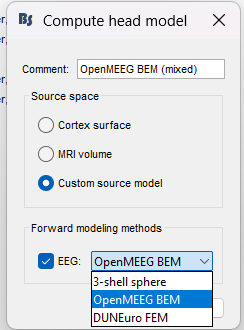
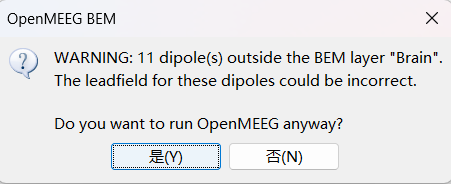
First, I strictly followed the DBA tutorial to build a mixed head model containing both cortical structures and hippocampus. When computing the head model, I only had three forward modeling options and selected the BEM method. However, a warning popped up: 11 dipoles are located outside the brain. I would like to ask how to solve this out-of-brain dipole issue in the mixed model workflow.
Second, I tried another simpler pipeline without constructing the DBA mixed model:
I set the source space to MRI volume in Compute Head Model, chose BEM for forward modeling, and selected cortex for the regular grid. After head model calculation, I computed sources with sLORETA, and finally extracted hippocampal time series using the AAL3 atlas.
I would like to ask:

  1. Compared with the DBA mixed model, is this MRI volume based pipeline more suitable and reliable for extracting deep hippocampal signals?
  2. What settings or parameters do I need to adjust in my current volume pipeline to obtain more accurate and stable hippocampal time series with 64-channel EEG?
    I would appreciate it if you could give me some practical suggestions. Thank you again for your generous help.

Dear Brainstorm community,

I am struggling with extracting hippocampal time series using 64-channel resting-state EEG (default ICBM152 template) and have tried multiple pipelines, but encountered dipole warnings and uncertainties about the correctness of my methods. I would greatly appreciate any advice.

1: DBA Mixed Model

I followed the DBA tutorial to build a mixed head model combining cortical and hippocampal structures. When computing the head model, I only had three forward modeling methods to choose from: 3-shell sphere, OpenMEEG BEM, DUNEuro FEM. I selected the OpenMEEG BEM method, but received a warning: 11 dipoles are located outside the brain. How can I resolve this dipole out-of-brain warning?

image

image451×184 8.26 KB

image

image460×139 6.83 KB

2:MRI volume
I then tried a different workflow without the DBA mixed model, and made several adjustments to the source grid settings, with the following details:

First attempt: Compute Head Model → Source space = MRI VOLUME, Forward method = OpenMEEG BEM, Regular grid = cortex. Then computed sources with sLORETA and extracted hippocampal time series using the AAL3 atlas. But I later realized this grid is built on the cortical surface and may not include the hippocampus (a deep subcortical structure).

Second attempt: Changed Regular grid from "cortex" to inner skull to cover deeper structures, but still got the same dipole-outside-brain warning.

Third attempt: Increased the number of vertices per layer from 1982 to 2562, but the dipole warning persisted.

Current setup: Switched Regular grid to Generate from cortex surface (adaptive) in the volume source grid settings.

image

image516×478 14.2 KB

My Key Questions:1.Is the volume-based pipeline (MRI volume + BEM + sLORETA + AAL3) more reliable than the DBA mixed model for extracting hippocampal time series with 64-channel EEG?2.Is extracting hippocampal time series using the volume source grid with "Generate from cortex surface (adaptive)" setting reasonable? Will this adaptive grid effectively cover the deep hippocampal region?

3.How can I completely resolve the "dipoles located outside the brain" warning in both the mixed model and volume-based pipeline?

Thank you very much for your help and guidance. Any practical suggestions would be greatly appreciated!

The approaches are different as they rely on different assumptions. The one that is more suitable depends on your research question and hypotheses.

It is not likely, you are still using the cortex surface as guide to make the 3D grid, but the structures you are interested are not inside that closed surface.

The grid is not on the cortical surface, the grid is a 3D grid comprising the volume inside the cortex surface. Thus it does not include grid points in the hippocampus.

You may need to check other works working with EEG and hippocampus source estimation, and check their hypotheses, head modeling, and source estimation in there.

Check this link to address the warning:
https://neuroimage.usc.edu/brainstorm/Tutorials/TutBem#Warning:_Dipoles_outside

Dear Mr. Raymundo Cassani,

Thank you very much for your previous replies and guidance, which have been extremely helpful for my source analysis workflow.

Following your suggestion, I have resolved the dipole-outside-the-brain warning and have been working through the official DBA tutorial. I downloaded the TutorialDba.zip and used the provided Colin27 template to build a mixed head model combining both cortical and hippocampal structures. I then performed source localization using the BEM forward model and sLORETA inverse solution, and computed power spectral density (PSD) for both the hippocampus and prefrontal cortex.

For the prefrontal cortex, I defined ROIs using the Desikan–Killiany (DK) atlas, while for the hippocampus I used the custom mixed atlas created in the DBA tutorial. However, I found the PSD values from both regions are extremely small, around 10⁻²⁰, with the maximum relative power only reaching about 0.035. I wonder if this is normal for mixed-model source signals, or if there might be any common pitfalls or adjustments I should consider when computing PSD from this pipeline.

In addition, the 2021 warning in the DBA tutorial notes that mixed head models are mainly intended for individual analysis and are not suitable for group-level studies. My research requires group-level statistical analysis, so I am now considering switching to the volume-based pipeline: MRI Volume + BEM + sLORETA + AAL3 atlas, with the regular grid set to inner skull to ensure coverage of deep structures like the hippocampus.

Could you please confirm whether this volume-based approach is indeed more suitable and reliable for my group-level analysis, especially for extracting hippocampal and prefrontal time series for PSD comparison?

Thank you again for your time and support.

Hi,Raymundo.Cassani
Thank you very much for your previous replies and guidance, which have been extremely helpful for my source analysis workflow.

My goal is to extract time series from the hippocampus and prefrontal cortex for subsequent group-level statistical analysis. I have a few follow-up questions regarding the most appropriate pipeline for my dataset, as I do not have individual MRI scans and am working with a standard template for electrode registration.

First, regarding the DBA mixed head model tutorial, I noticed the 2021 warning that mixed models are mostly intended for individual analysis and not suitable for group studies when using individual anatomy. However, since I am using a common template for all subjects, would it be valid to use the mixed model to extract hippocampal time series while using the DK atlas for prefrontal cortex ROIs for group analysis?

Second, I also tried the volume-based pipeline (MRI Volume + OpenMEEG BEM + sLORETA + AAL3 atlas) with the regular grid set to `inner skull`, but I encountered persistent “dipoles outside the brain” warnings. I followed your suggested troubleshooting steps but have not been able to resolve this issue yet.

As an alternative, I am considering two adjustments:

  1. Switching the regular grid to `cortex` instead of `inner skull`; however, I am concerned this might not include the deep hippocampal structures.
  2. Using the 3-shell sphere forward model instead of BEM, with the regular grid still set to `inner skull`.

Could you please advise which of these options would be more reliable for covering the hippocampus while minimizing dipole warnings, or if there is a better workflow for my group-level analysis with a standard template?

Thank you again for your time and support.

That sounds right, remember that the source activations are in pA.m, (10^-12).

For which frequency? Keep in mind that lower frequencies contribute the most to the total power, which is used to compute the relative power.

This warning is about the current impossibility of aggregate results from individual mixed models. If you use the same mixed model (derived from the Default anatomy) this warning does not apply to you.

Report which of the provided approaches to fix this issue was tested?

A volume grid computed using the cortex surface will not contain the hippocampus

In the case of EEG, OpenMEEG provides a more realistic head model which leads to more accurate results than the spherical models.

Hi,Raymundo.Cassani

Thank you again for your guidance. I have a few follow-up questions regarding my current troubleshooting attempts with the volume-based pipeline.

First, I tested setting the Regular grid to cortex in the MRI Volume source space. When previewing the source grid, I noticed that green source points also appear in the deep brain structures, not just on the cortical surface. Could you please confirm whether setting the regular grid to cortex would still allow sufficient coverage of the hippocampus for reliable time series extraction?

Second, I have tried multiple methods to resolve the persistent "dipoles located outside the brain" warning:

  • Increasing the number of vertices for the BEM layers to 2562, 3242, and 4322

  • Using the Force inside skull option

  • Performing manual inward contraction of the source grid

Unfortunately, none of these steps have fully eliminated the warning. I would greatly appreciate any further advice on what might be causing this issue, or if there is an alternative workflow I should consider.

Thank you for your time and support.

Hello

I extracted source time series (hippocampus & prefrontal) using DBA + sLORETA.

When I compute PSD:

  1. Using Brainstorm’s built-in PSD function

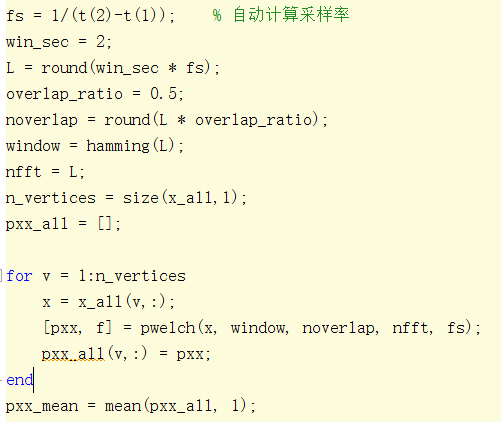
  2. Exporting the same time series and computing PSD in MATLAB with pwelch

The two PSD outputs are very different in amplitude and relative power, even with matched parameters.

I have checked window size, overlap, and frequency range.

Could this be due to scaling, normalization, or unit conversion in Brainstorm?

Which one should I trust for group analysis?

Thank you!

In the post above two different things are being computed:

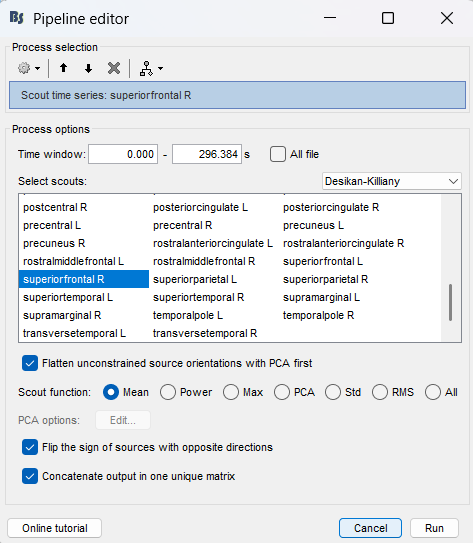
A. Using the PSD process, the PSD for scout superiorfrontal R is computed:

  1. PSD is computed for each vertex in the Scout
  2. The final PSD is computed as the mean across vertices
    (This is indicated in the Scout function option After:
    "Compute TF (PSD in this case) and then apply the (Scout) function"

B. Using the custom script, the PSD for scout superiorfrontal R is computed:

  1. One time series is obtained for the Scout as the mean of the time series of the vertices that comprise the Scout
  2. The PSD is computed on the mean Scout time series


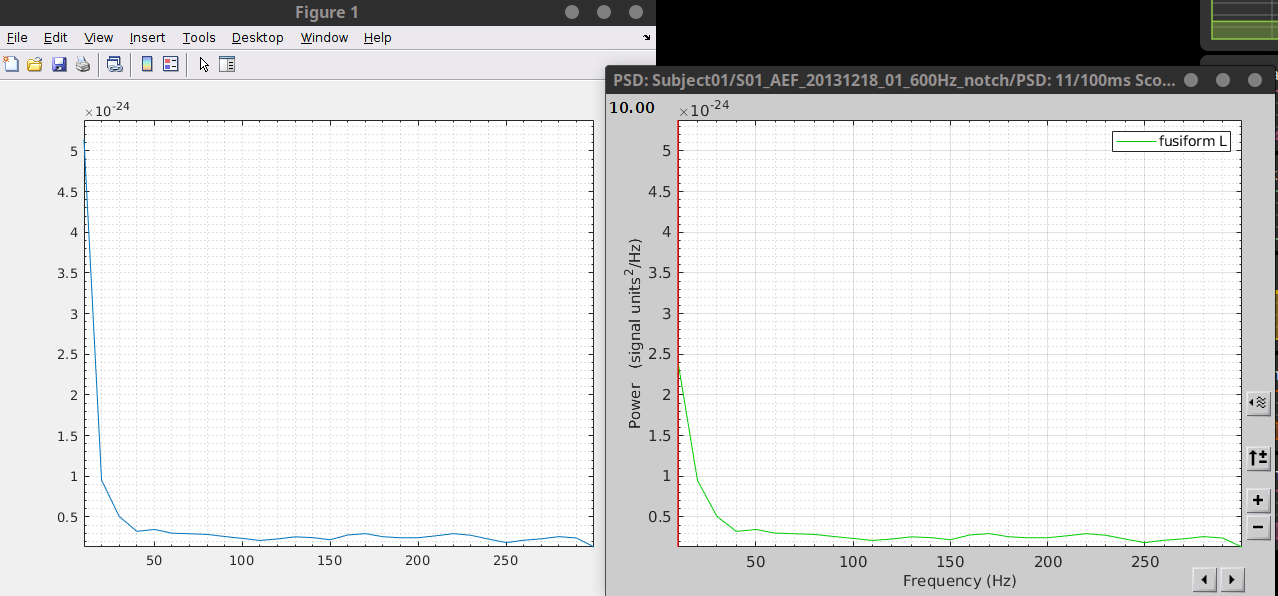
Considering the In the case, that all the time series in the scout (one per vertex) were exported using the All option so, the variable x_all has the size ([nVertices, nTime]). Both approaches would lead to similar results, except for the first bin, i.e., at 10 Hz[1].

Be sure of using the same axes limits:


Left: PSD computed as the mean of each vertex PSD in the Scout, using custom script
Right PSD computed with the PSD process.


You can use the PSD process to avoid reinventing the wheel.
The code for that computation can be found in here:


  1. In Brainstorm PSD computation using the Welch's method, besides being Hamming windowed, the DC component is removed from each window, thus reducing its leak into the first bins of the PSD. ↩︎