
|
Size: 4664
Comment:
|
Size: 4739
Comment:
|
| Deletions are marked like this. | Additions are marked like this. |
| Line 16: | Line 16: |
| [[attachment:pet_processing_pipeline.png]] |
|
| Line 20: | Line 18: |
| <<BR>> {{attachment:pet_method_import.png}} | |
| Line 24: | Line 22: |
| * Select the menu '''File > Create new protocol'''. Name it "'''XXXXXX'''" and select the options: <<BR>>"'''No, use individual anatomy'''",<<BR>>"'''No, use one channel file per acquisition run'''". | * Select the menu '''File > Create new protocol'''. Name it "'''XXXXXX'''" and select the options: <<BR>>"'''No, use individual anatomy'''",<<BR>>"'''No, use one channel file per acquisition run'''". |
| Line 27: | Line 27: |
| * Go to the '''Anatomy view''' * Right-click on the '''XXXXXX''' top node > '''New subject''' > '''Subject01'''.<<BR>>Keep the default options you defined for the protocol. * Switch to the '''Anatomy''' view of the protocol. * Right-click on the subject node > '''Import MRI'''.<<BR>>Set the file format: '''MRI: NIfTI-1 (*.nii;*.nii.gz)???'''.<<BR>>Select: '''???????.nii''' |
* Go to the '''Anatomy view''' |
| Line 32: | Line 30: |
| * The MRI viewer opens automatically. Click on "[[http://neuroimage.usc.edu/brainstorm/Tutorials/ImportAnatomy#MNI_normalization|Click here to compute MNI normalization]]", option "'''maff8'''". | * Right-click on the '''XXXXXX''' top node > '''New subject''' > '''Subject01'''.<<BR>>Keep the default options you defined for the protocol. |
| Line 34: | Line 33: |
| * Click on '''Save''' to close the MRI viewer. New node named '''preMRI''' is created.<<BR>><<BR>> | * Switch to the '''Anatomy''' view of the protocol. * Right-click on the subject node > '''Import MRI'''.<<BR>>Set the file format: '''MRI: NIfTI-1 (*.nii;*.nii.gz)???'''.<<BR>>Select: '''???????.nii''' * The MRI viewer opens automatically. Click on "[[http://neuroimage.usc.edu/brainstorm/Tutorials/ImportAnatomy#MNI_normalization|Click here to compute MNI normalization]]", option "'''maff8'''". * Click on '''Save''' to close the MRI viewer. New node named '''preMRI''' is created.<<BR>><<BR>> |
| Line 39: | Line 51: |
| * Right-click on the subject node > '''Import PET'''.<<BR>>Select: '''????.nii''' * Choose '''Yes''' for the transformation for '''MRI orientation'''.<<BR>> |
* Right-click on the subject node > '''Import PET'''.<<BR>>Select: '''????.nii''' * Choose '''Yes''' for the transformation for '''MRI orientation'''.<<BR>> |
| Line 42: | Line 58: |
| . <<BR>> {{attachment:pet_import_opts.png}} | . <<BR>> {{attachment:pet_import_opts.png}} |
| Line 44: | Line 61: |
| * '''Align frames''': Description on what happens, method, etc <<BR>> Check this option | |
| Line 46: | Line 62: |
| * '''Apply smoothing''': Description <<BR>> Check this option, and set FWHM to '''XX mm''' | * '''Align frames''': Description on what happens, method, etc <<BR>> Check this option |
| Line 48: | Line 65: |
| * '''Aggregate frames''': Description <<BR>> Select '''mean''' | |
| Line 50: | Line 66: |
| * '''Register to MRI using:''': Description <<BR>> Check this option, and set method to '''SPM''' | * '''Apply smoothing''': Description <<BR>> Check this option, and set FWHM to '''XX mm''' |
| Line 52: | Line 69: |
| * '''Reslice volume:''': Description <<BR>> Check this option | * '''Aggregate frames''': Description <<BR>> Select '''mean''' * '''Register to MRI using:''': Description <<BR>> Check this option, and set method to '''SPM''' * '''Reslice volume:''': Description <<BR>> Check this option |
| Line 60: | Line 89: |
| * [[http://neuroimage.usc.edu/brainstorm/Tutorials/ImportAnatomy|Import the subject anatomy]] | * [[http://neuroimage.usc.edu/brainstorm/Tutorials/ImportAnatomy|Import the subject anatomy]] |
| Line 63: | Line 94: |
| * Nolte G, Bai O, Wheaton L, Mari Z, Vorbach S, Hallett M. <<BR>> [[https://doi.org/10.1016/j.clinph.2004.04.029|Identifying true brain interaction from EEG data using the imaginary part of coherency]]. <<BR>> Clinical Neurophysiology. 2004 Oct;115(10):2292–307. | * Nolte G, Bai O, Wheaton L, Mari Z, Vorbach S, Hallett M. <<BR>> [[https://doi.org/10.1016/j.clinph.2004.04.029|Identifying true brain interaction from EEG data using the imaginary part of coherency]]. <<BR>> Clinical Neurophysiology. 2004 Oct;115(10):2292–307. |
| Line 66: | Line 99: |
| * Overlaying PET on cortex: https://neuroimage.usc.edu/forums/t/30241 | * Overlaying PET on cortex: https://neuroimage.usc.edu/forums/t/30241 |
PET processing in Brainstorm
Authors: Diellor Basha
This describes how to import and process PET volumes to perform multimodal analyses in Brainstorm...
Introduction
Positron Emission Tomography (PET) is a powerful imaging technique widely used in medical and scientific research to study metabolic and functional processes in the body. PET processing involves a series of computational and analytical steps to transform raw data into meaningful visualizations and quantitative insights. These steps ensure accurate reconstruction, correction, and analysis of PET scans, enabling researchers and clinicians to draw precise conclusions.
This page provides an overview of the essential methods, tools, and considerations involved in PET processing, aiming to support both newcomers and experienced users in achieving optimal results. Whether you're exploring biological pathways, assessing disease progression, or validating experimental findings, understanding the fundamentals of PET processing is key to leveraging the full potential of this versatile imaging modality.
Method Overview
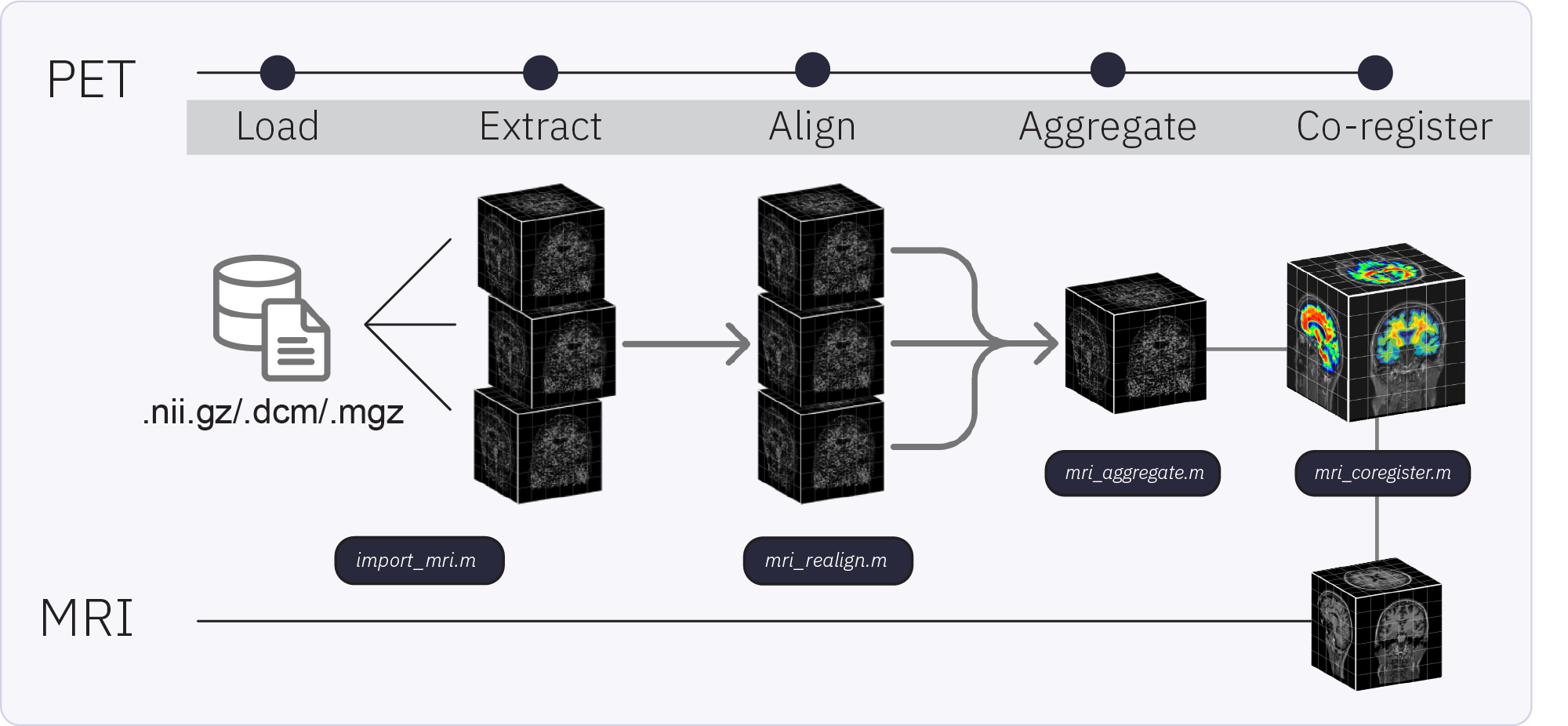
The Brainstorm extension for PET supports importing, processing, registering, visualizing, and analyzing PET data within Brainstorm. PET functionality and workflow are designed to facilitate the analysis of multimodal neuroimaging data by allowing the user to co-analyze MEG, PET and MRI-derived data. Multi-frame (4D) PET volumes are realigned during import and aggregated over time from the 4D image (i.e. mean of the n frames) to obtai a unique 3D volume for co-registration with the subject’s structural MRI. Multi-frame PET volumes are realigned using SPM’s realign and reslice functions and co-registered with SPM. The aggregated and co-registered 3D volume is masked and rescaled to obtain voxel-wise standardized uptake value ratio (SUVR) which are then projected to the cortical surface.
Import the anatomy
- Start Brainstorm
Select the menu File > Create new protocol. Name it "XXXXXX" and select the options:
"No, use individual anatomy",
"No, use one channel file per acquisition run".
Reference MRI
Go to the Anatomy view
Right-click on the XXXXXX top node > New subject > Subject01.
Keep the default options you defined for the protocol.Switch to the Anatomy view of the protocol.
Right-click on the subject node > Import MRI.
Set the file format: MRI: NIfTI-1 (*.nii;*.nii.gz)???.
Select: ???????.niiThe MRI viewer opens automatically. Click on "Click here to compute MNI normalization", option "maff8".
Click on Save to close the MRI viewer. New node named preMRI is created.
PET volume
The MRI volume above will be used as the anatomical reference for this subject. We will now import a PET scan done on the same subject. In this dataset, PET scan corresponds to XXXX.
Right-click on the subject node > Import PET.
Select: ????.niiChoose Yes for the transformation for MRI orientation.
- Choose the import options for PET
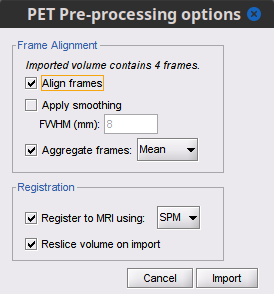
Align frames: Description on what happens, method, etc
Check this optionApply smoothing: Description
Check this option, and set FWHM to XX mmAggregate frames: Description
Select meanRegister to MRI using:: Description
Check this option, and set method to SPMReslice volume:: Description
Check this option
You can also decide to not perform any of these actions, and perform them once the PET volume is imported. IMAGE OF CONTEXT MENUS, for frame alignment and co-registration
Additional documentation
Related tutorials
Articles
Nolte G, Bai O, Wheaton L, Mari Z, Vorbach S, Hallett M.
Identifying true brain interaction from EEG data using the imaginary part of coherency.
Clinical Neurophysiology. 2004 Oct;115(10):2292–307.
Forum discussions
Overlaying PET on cortex: https://neuroimage.usc.edu/forums/t/30241