BEst - wavelet-based source localization
This toolbox implements the "maximum-entropy on the mean" (MEM) technique for solving MEG, EEG and fused MEEG inverse problems. Along with the classical MEM, we exploit wavelet decompositions of the data in order to target specifically oscillatory (wMEM) and synchronous cortical sources (rMEM). BEst, for "Brain Entropy in space and time", is the result of a collaborative work between École de Technologie Supérieure and the department of biomedical enginnering at McGill university (Montreal, Canada). The present tutorial shows how to use MEM on MEG CTF-sample data that can be downloaded here.


See below for more info on the BEst license and the associated publications.
MEM: quick steps
We need one gain matrix for each recording modality considered for source localization. These matrices can be computed within Brainstorm using either, sperical or realistic (recommended) head models. See the tutorial on Head models for details. Note that unlike the other methods proposed in Brainstorm, the MEM does not require prior calculation of a noise covariance matrix. In fact, this matrix is estimated using a baseline signal that can either be part of the data to localize or come from a different data.
- Select the TutorialCTF protocol
- Go to the data view (second button on top of the database explorer)
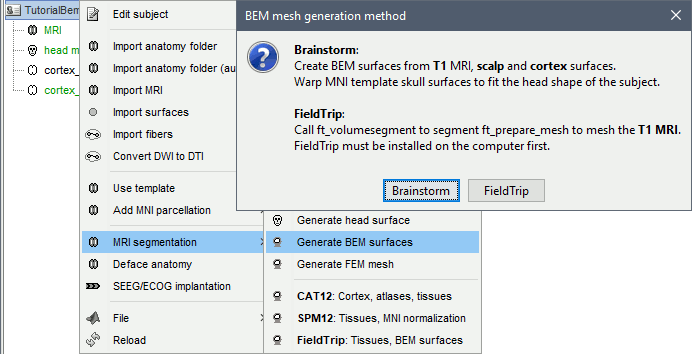
Right-click on a trial som**** > Compute sources...You can set the approximate number of vertices you want for each layer. Leave the default parameters and click on Ok.
- At the end of the process, three new surfaces are added to the database:


Forward model
- Switch to the view "Functional data (sorted by subjects)"
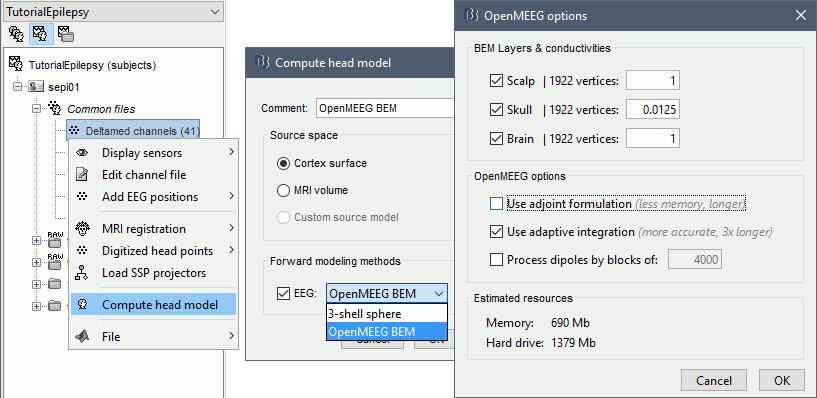
Right-click on Subject01 / Right > Compute head model. Select OpenMEEG BEM in the list. Click on Run.
- Explanations of the options:
BEM Layers & conductivities: In this panel you can select how many layers you want to use for the BEM model. The possible options in our case are Scalp (=head), Skull (=outer skull), and Brain (=inner skull). The values on the right are the relative conductivities of each layer.
- For EEG: Use all the layers
- For MEG: Use only the inner skull layer
Use adjoint formulation: Decrease significantly the amount of memory that is necessary in memory and on the hard drive, but much longer.
Use adaptive integration: This produces a much more accurate solution, mostly in the cases of dipoles (vertices of the cortex surface) that are very close to the inner skull layer. You should keep this option selected.
Process dipoles by blocks: If you consistently run into crashes, it's probably because you don't have enough memory available. You can try to process the dipoles by smaller blocks. It would be longer but would probably work. Do not select unless you cannot compute the solution with having memory errors.
- Download OpenMEEG software? Yes.
- This will download the latest version of OpenMEEG binaries for your operating system from INRIA website, and install it in Brainstorm user folder (~username/.brainstorm/openmeeg/)
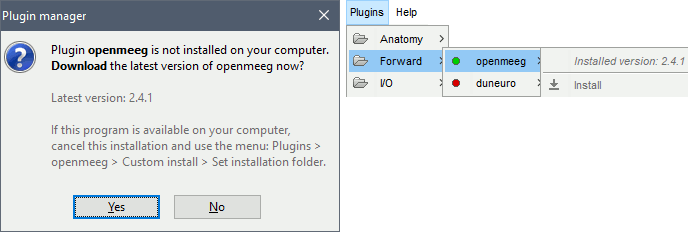
- This will download the latest version of OpenMEEG binaries for your operating system from INRIA website, and install it in Brainstorm user folder (~username/.brainstorm/openmeeg/)
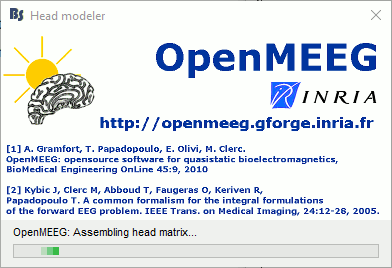
- Once downloaded, the calculation of the head model will start automatically. You may wait for a very long time. Be patient, it's worth it...
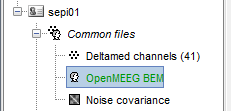
- You have now a new head model in your condition, that you can use exactly the same way you would use your previous "Overlapping sphere" model.

License
OpenMEEG is distributed under the French opensource license CeCILL-B. It is intended to give users the freedom to modify and redistribute the software. It is therefore compatible with popular opensource licenses such as the GPL and BSD licenses. The CeCILL-B license imposes to anybody distributing a software incorporating OpenMEEG the obligation to give credits (by citing the appropriate publications), in order for all contributions to be properly identified and acknowledged.
The references to be acknowledged are:
Gramfort, T. Papadopoulo, E. Olivi, M. Clerc. OpenMEEG: opensource software for quasistatic bioelectromagnetics, BioMedical Engineering OnLine 45:9, 2010
Kybic J, Clerc M, Abboud T, Faugeras O, Keriven R, Papadopoulo T. A common formalism for the integral formulations of the forward EEG problem. IEEE Transactions on Medical Imaging, 24:12-28, 2005. [pdf]