
BEst - wavelet-based source localization
This toolbox implements the "maximum-entropy on the mean" (MEM) technique for solving MEG, EEG and fused MEEG inverse problems. Along with the classical MEM, we exploit wavelet decompositions of the data in order to target specifically oscillatory (wMEM) and synchronous cortical sources (rMEM). BEst, for "Brain Entropy in space and time", is the result of a collaborative work between École de Technologie Supérieure and the department of biomedical enginnering at McGill university (Montreal, Canada). The present tutorial shows how to use MEM on averaged MEG Tutorial UQAMwork data that can be downloaded here.


See below for more info on the BEst license and the associated publications.
MEM: quick steps
We need one gain matrix for each recording modality considered for source localization. These matrices can be computed within Brainstorm using either, sperical or realistic (recommended) head models. See the tutorial on Head models for details. Note that unlike the other methods proposed in Brainstorm, the MEM does not require prior calculation of a noise covariance matrix. In fact, this matrix is estimated using a baseline signal that can either be part of the data to localize or come from a different data.
- Select the TutorialCTF protocol
- Go to the data view mode (second button on top of the database explorer)
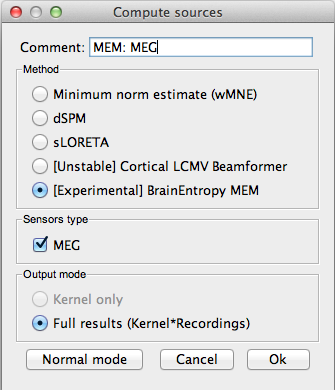
Right-click on the data average > Compute sources > BrainEntropy MEM.. Hit 'Ok' Note: The MEM option only appears in expert mode. Make sure it is toggled from the buttom at the bottom left. It is recommended that you personnalize the comment field so as to avoid confusion when performing multiple localizations for a given dataset

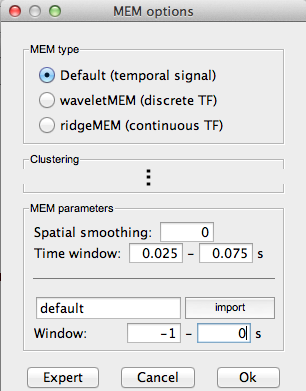
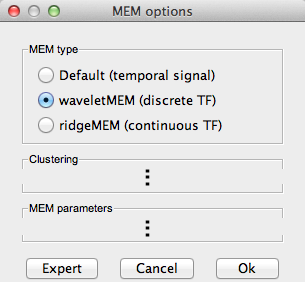
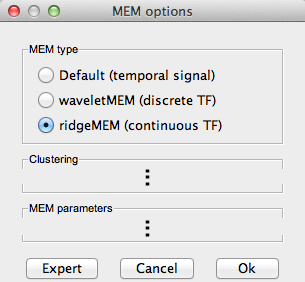
- Select the MEM pipeline (MEM, wMEM or rMEM). For now, we leave the 'Clustering' options to default values, these are described here.
You can select a specific time window for source localization. This option can be necessary for long data epochs, as MEM is a slow iterative process (default: localize all data). Note: this option is not considered for the wMEM (localize whole data)
- By default, the panel looks for a data called 'baseline' within the same study as the data to be localized. When not found, the baseline is the data segment specified in the field 'Window'. You can select an external baseline by hitting 'import'.
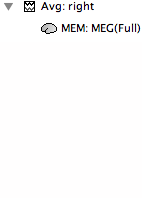
- Hitting 'Ok' will launch the MEM pipeline. At the end, a new results file appears in the database under the appropriate dataset. Simply double-click it to visualize.



MEM and wavelets
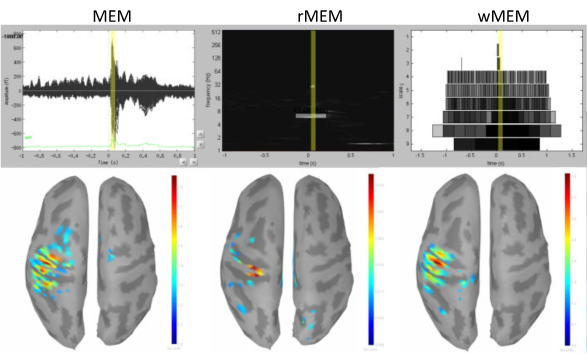
The most innovative aspect of the BEst toolbox is the application of the entropic source localization methodology (MEM) on wavelet coefficients. The aim of this approach is to localize neural sources responsible for a specific activity such as oscillations and synchrony. We introduce two kinds of wavelet transforms, continuous (rMEM) and discrete (wMEM), which explicit the synchronous and oscillatory components, respectively. The coefficient selection process and complete methodological steps are described in reference papers (rMEM, wMEM).
wMEM: The signal is decomposed into discrete time-scale coefficients using real Daubeachies wavelets. The time-scale plane can then be thresholded to keep only significant coefficients, up to a fraction of total signal power. The MEM is then used to localize the sources of each coefficient, thus yielding time-scale planes for each source. As we keep only significant oscillatory modes from the time-scale planes, this method efficiently targets the oscillating neural sources. Interestingly, real Daubechies wavelets have a stable inverse transform, which allows us to retrieve reald time course for each source.
rMEM: The signal is decomposed into continuous time-frequency plane using analytic Morse wavelets. We then extract multivariate ridges from these planes, and extract the complex coefficients along the ridge lines. The sources of these complex signals are then localized using the MEM. As the ridges reflect synchronous signal components, the rMEM targets synchronous sources. The following figure illustrates the results obtained by the MEM solver and the wavelet-based MEM on Brainstorm tutorial data.
MEM fine-tuning : cortex clustering
The major prior of the MEM is that cortical activity is compartmented into discrete parcels. The activity of a given source within a patch is thus linked to the activity of its neighbors. This step is thus important for the MEM and we propose some strategies to optimize it, depending on the type of activity we target for source localization. All these approaches are data-driven and consist in two steps: sources scoring and labelling.
Sources scoring : MSP
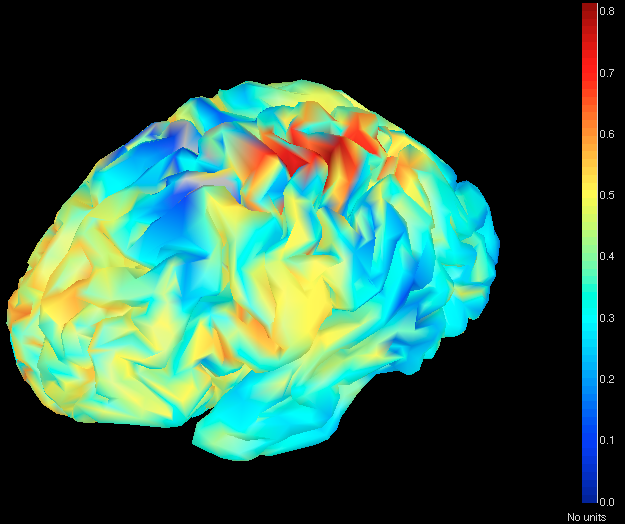
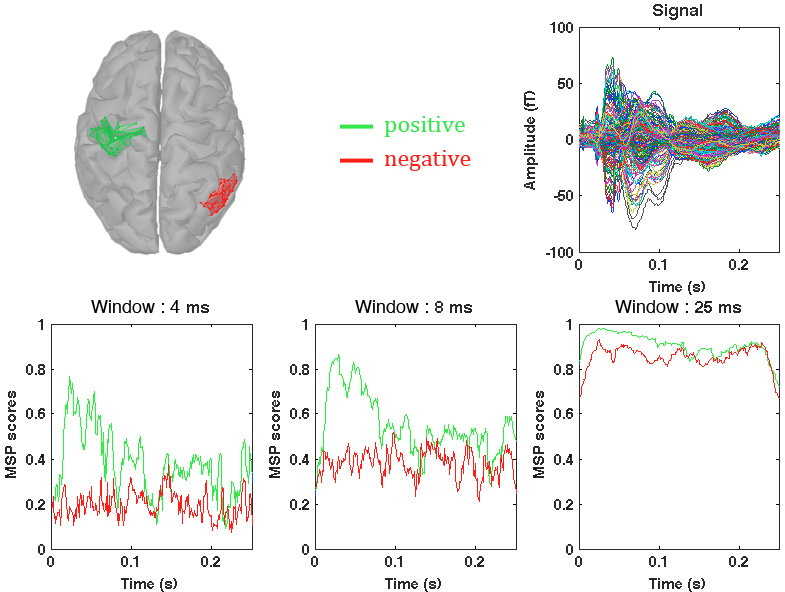
We first attribute a score to each source indicating its probability of explaining a segment of data. These scores are drawn using the multivariate source prelocalisation technique - MSP (Mattout et al. 2005, NeuroImage). The MSP proceeds by computing a signal space projector using the SVD of the normalized data segment. The leadfields of each source are then normalized and projected on that space. The L2 norm of that projection thus gives a probability-like index between 0 and 1 weighing the contribution of each source to the data (illustrated in the following figure).
Note:
The MSP quantifies the probability for each source to explain some variability in a data segment. Implicitly, we expect the MSP scores to discriminate active regions from inactive ones in relation to the analyzed data window. In this regard, the size of the data window is an important issue. If it is too short, the variability to be explained is low and all sources will have low scores. At the opposite, if it is too large, all sources will have high MSP scores. We thus adopt two MSP strategies to obtain appropriate MSP scores distributions:
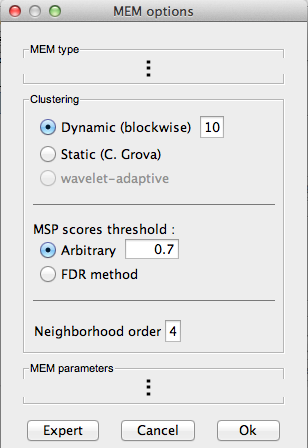
windowed MSP: (options 'blockwise' and 'wavelet-adaptive') aims at using fairly short segments of data. The size of the data segment can either be set arbitarily ('blockwise') based on empirical observations, or adapted to the temporal support of the wavelet at a given scale/frequency (only applies to wavelet-based MEM). The 'blockwise' procedure is a sliding window that computes a set of MSP scores at each time sample, thus yielding a MSP time course for each source (illsutrated in the next figure), while 'wavelet-adaptive' procedure computes a set of MSP scores for each time-frequency coefficient, thus yielding MSP time-frequency planes. These scores are then used for clustering.

canonical MSP: (option 'static') This method hypothesizes that the sources explaining the series at hand are spatially stable in time and have uncorrelated time course. It thus aims at representing cortical activity as stable parcels with evolving MSP time courses. As the scoring and the clustering are intimately related in this approach, the reader is referred to the following paper for a complete description (Chowdhury et al. 2012, NeuroImage). Briefly, we extract main components from data and build cortical patches containing sources mostly related to either one of the extracted components. The outcome of the operation is a spatially stable clustering in time but with varying MSP time courses.
Sources clustering : dynamical
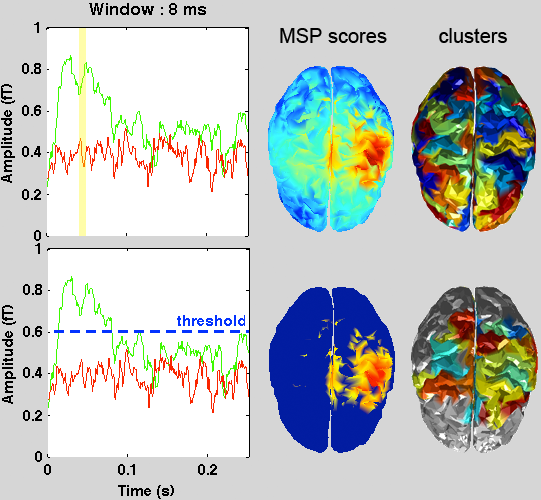
The aim of this step is to group cortical sources into spatially homogenous cortical parcels based on their MSP scores. The clustering alogrithm described next is applied at each time sample thus allowing sufficient flexibility for tracking spatially moving sources while still being able to describe spatially stable sources. It proceeds as follows:
- list all vailable sources in a vector
- pick the source i with maximal MSP score
- find the neighbours of i up to the 'neighborhood order' value
- remove i and its neighbors from the list
- repeat steps 2-4 until the list is empty
Note:
It is posible to apply a threshold on the MSP scores before applying the clustering. The threshold can either be set manually or derived from a baseline using an FDR criterion (see following figure). In that case, the sources with subthreshold MSP scores are excluded from step 1 and are not part of any cluster. These sources will not be part of the MEM solution.
License
BEst is free software: you can redistribute it and/or modify it under the terms of the GNU General Public License as published by the Free Software Foundation, either version 3 of the License, or (at your option) any later version. BEst is distributed in the hope that it will be useful, but WITHOUT ANY WARRANTY; without even the implied warranty of MERCHANTABILITY or FITNESS FOR A PARTICULAR PURPOSE. See the GNU General Public License for more details. You should receive a copy of the GNU General Public License along with BEst. If not, get it here.
The references to be acknowledged are:
MEM with stable clustering. Chowdhury R, Lina JM, Kobayashi E, Grova C. MEG source localization of spatially extended generators of epileptic activity: cpmaring entropic and hierarchical bayesian approaches. PLoS One, 2012 (in revision)
wMEM. Lina JM, Chowdhury R, Lemay E, Kobayashi E, Grova C. Wavelet-based localization of oscillatory sources from magnetoencephalography data. IEEE Transactions on biomedical engineering, 2012 (Ahead of print)
rMEM. Zerouali Y, Herry C, Jemel B, Grova C. Localization of synchronous cortical neural sources. IEEE Transactions on biomedical engineering, 2011 (Ahead of print)
Additionnal references:
MSP. Mattout J, Pelegrini-Issac M, Granero L, Benali H. Multivariate source prelocalization (MSP): use of functionnaly informed basis functions for better conditioning the MEG inverse problem. NeuroImage 26: 356:373.
MEM. Amblard C, Lapalme E, Lina JM. Biomagnetic Sources Detection by Maximum Entropy on the Mean with Graphical Models, IEEE Transactions on Biomedical Engineering, 55(3): 427-442
minFunc. Schmidt M. see license